
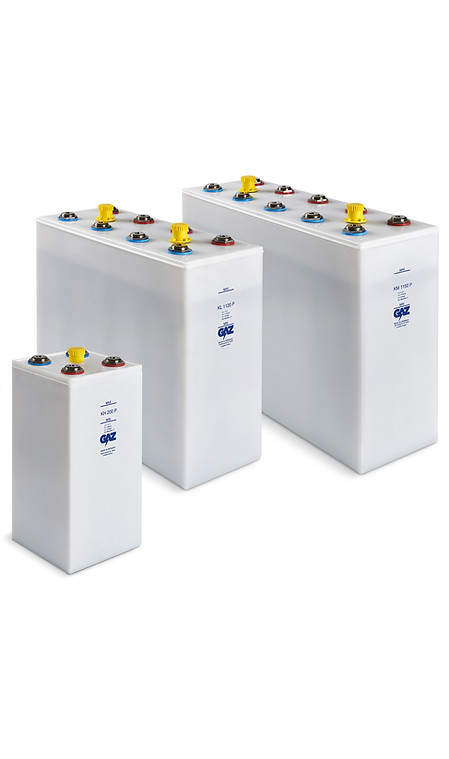
Ni-Cd 420
Length:
Width
Height:
Terminal:
Cells Per Unit:
Voltage Per Unit:
Capacity:
Weight:
Terminal:
Max Discharging Current:
Design Life:
Max Charging Current:
Reference Capacity:
Float Charging Voltage:
Cycle Use Voltage:
Operating Temperature Ranges:
Normal Operating Temperature Ranges:
Self Discharge:
Container Material:
164± 2mm (6.5 in)
158± 2mm (6.2 in)
394± 2mm (15.5 in)
M10 - 25~30 N*m
1
1.2
420Ah@5hr-rate to 1 V per cell @20°C
Approx. 18.5 Kg (Tolerance ± 3%) or 30.15 lbs.
2x(M10)
420A
20 Year (floating charge)
42.0A
C1 - 157.0 Ah
C3 - 291.0 Ah
C5 - 382.0 Ah
C10 - 401.0 Ah
1.40V-1.42V @20°C
Temperature Compensation: -3mV/°C/Cell
1.42V-1.44V @20°C
Temperature Compensation: -4mV/°C/Cell
Discharge: -30ºC~50ºC
Charge: -30ºC~50ºC
Storage: 10ºC~30ºC
20°C±5°C
This decrease is quite rapid during the first two weeks and then stabilizes at about 2 % per month at + 20 °C. In general the self-discharge of a Ni-Cd battery is affected by various temperatures. The open circuit loss is reduced at low temperatures; that is, the self-discharge is significantly increased at higher temperatures.
Polypropylene
Constant Current Discharge Characteristics: A(20ºC)
FV/Time | 10MIN | 30MIN | 1HR | 2HR | 3HR | 4HR | 5HR | 8HR | 10HR |
|---|---|---|---|---|---|---|---|---|---|
1 V | 402 | 349 | 269 | 160 | 113 | 94.3 | 84 | 52.8 | 42.4 |
1.05 V | 335 | 295 | 241 | 157 | 112 | 91.6 | 82.1 | 51.6 | 41.5 |
1.10 V | 272 | 241 | 202 | 149 | 109 | 89.8 | 80.2 | 50.7 | 40.9 |
1.15 V | 208 | 184 | 157 | 125 | 97 | 83.5 | 76.4 | 49.2 | 40.1 |
Discharge Characteristics Curve

Charge Characteristics Curve
for Cycle Use (IU)

Cycle Life In Relation to Depth of Discharge

Relationship Between Charging Voltage and Temperature

Temperature Effects on Capacity

Storage Characteristics

Effect of Temperature on Long Term Life

Relationship of OCV and State
of Charge (20ºC)
